Akari 1A — Isamu Noguchi
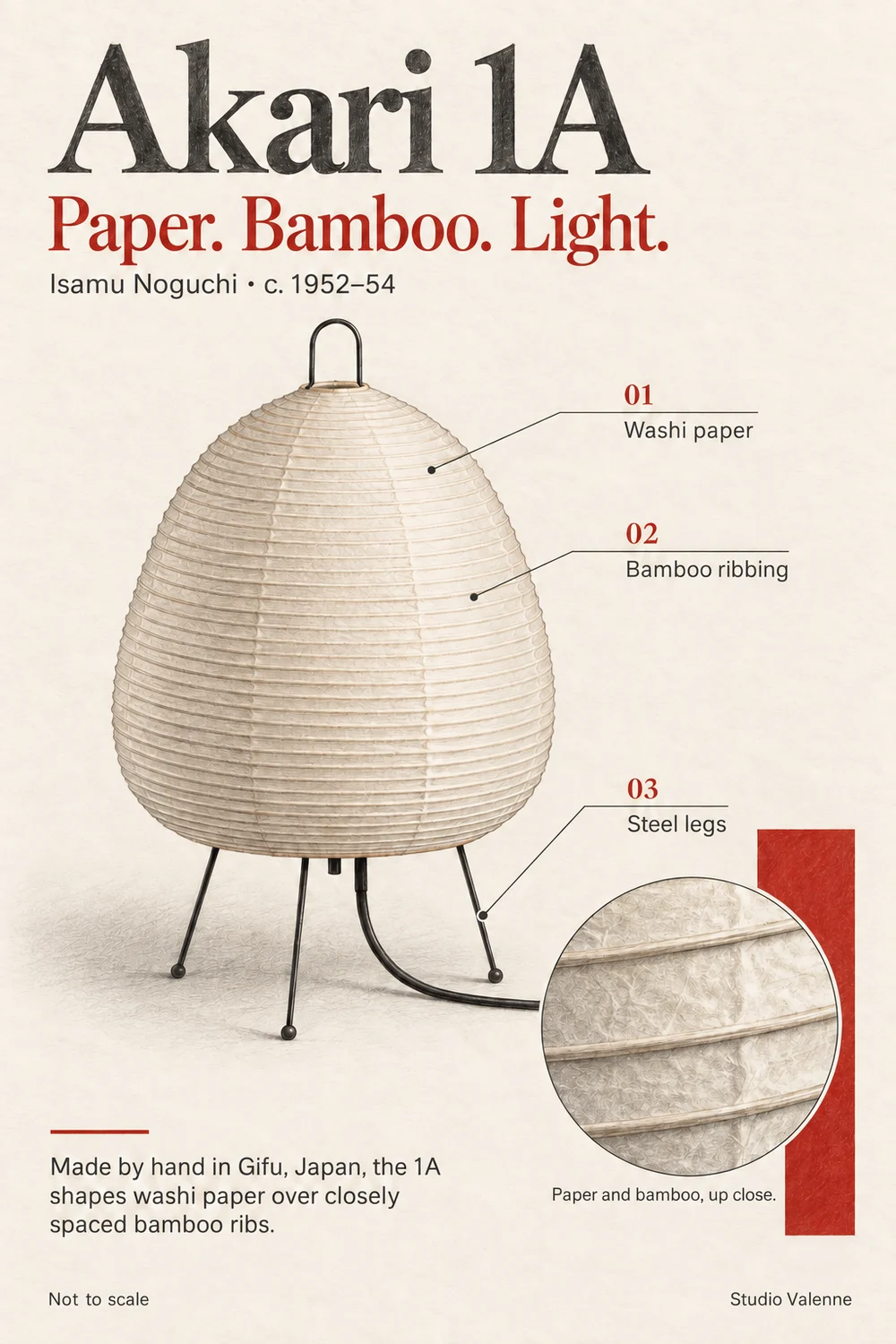
Noguchi began the Akari series in 1951. The Noguchi Museum dates the 1A model to around 1952–54, rather than simply assigning the series’ opening year to every lamp. It is made by hand in Gifu, Japan.
The shade combines washi paper and bamboo ribbing; slender steel legs lift it off the table. Closely spaced ribs give the paper its rounded form. Seen up close, the structure is part of the surface rather than something hidden behind it.
In the study, follow a rib around the shade and then compare its rhythm with the sparse lines of the legs. This contrast gives a light object a clearly legible structure.
CH24 — Hans J. Wegner
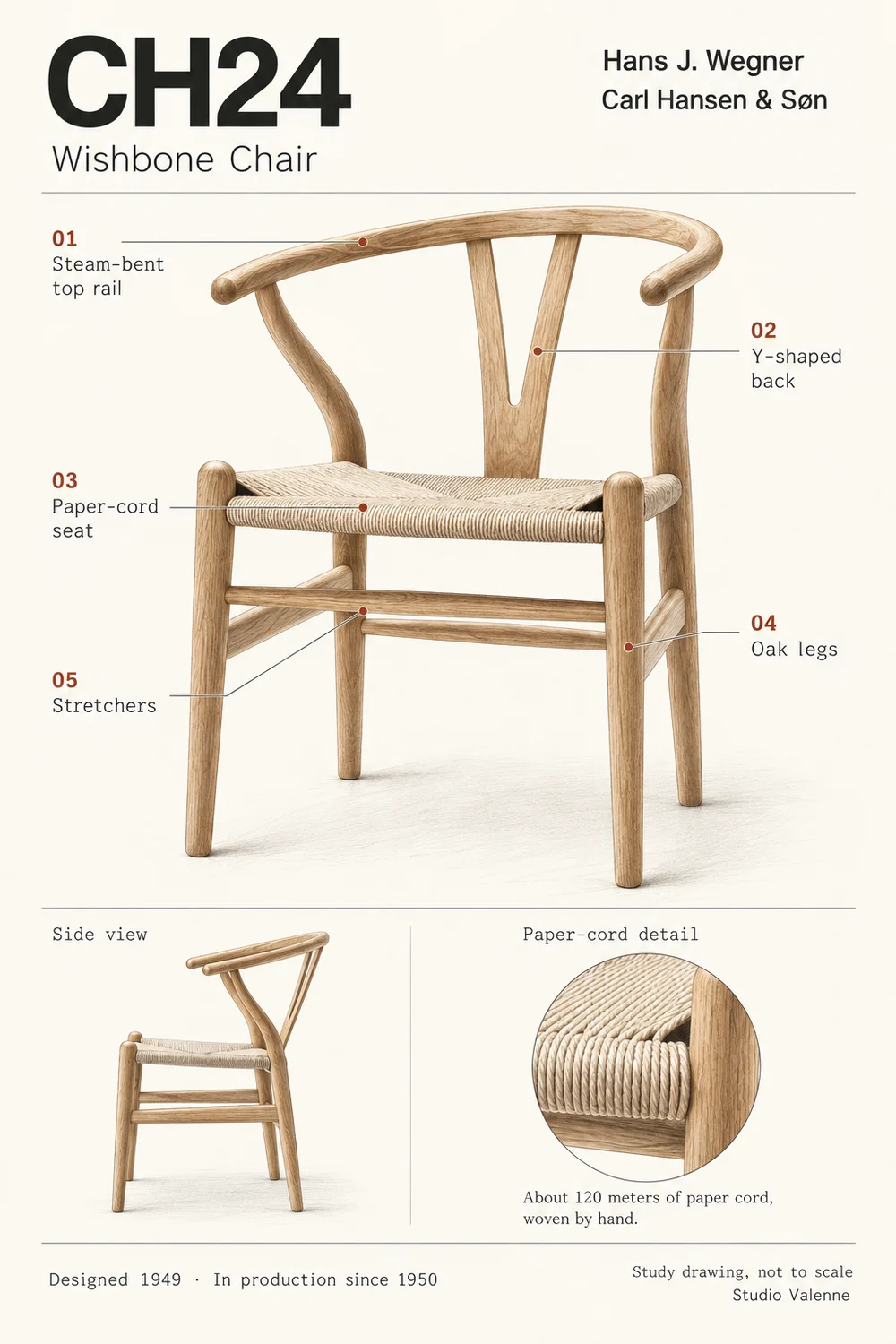
Wegner designed the CH24 in 1949; Carl Hansen & Søn began producing it in 1950. The Wishbone name points to the Y-shaped back support, but the chair also depends on the steam-bent top rail, which serves as both back and armrest.
The seat is woven by hand from approximately 120 metres of paper cord. In the oak version shown here, that tight woven surface sits inside a frame with open space beneath and around it.
Look at the change between the broad top rail, the narrow back support and the seat’s dense weave. The parts have different jobs, and their proportions let you read them separately.
Arco — Achille and Pier Giacomo Castiglioni
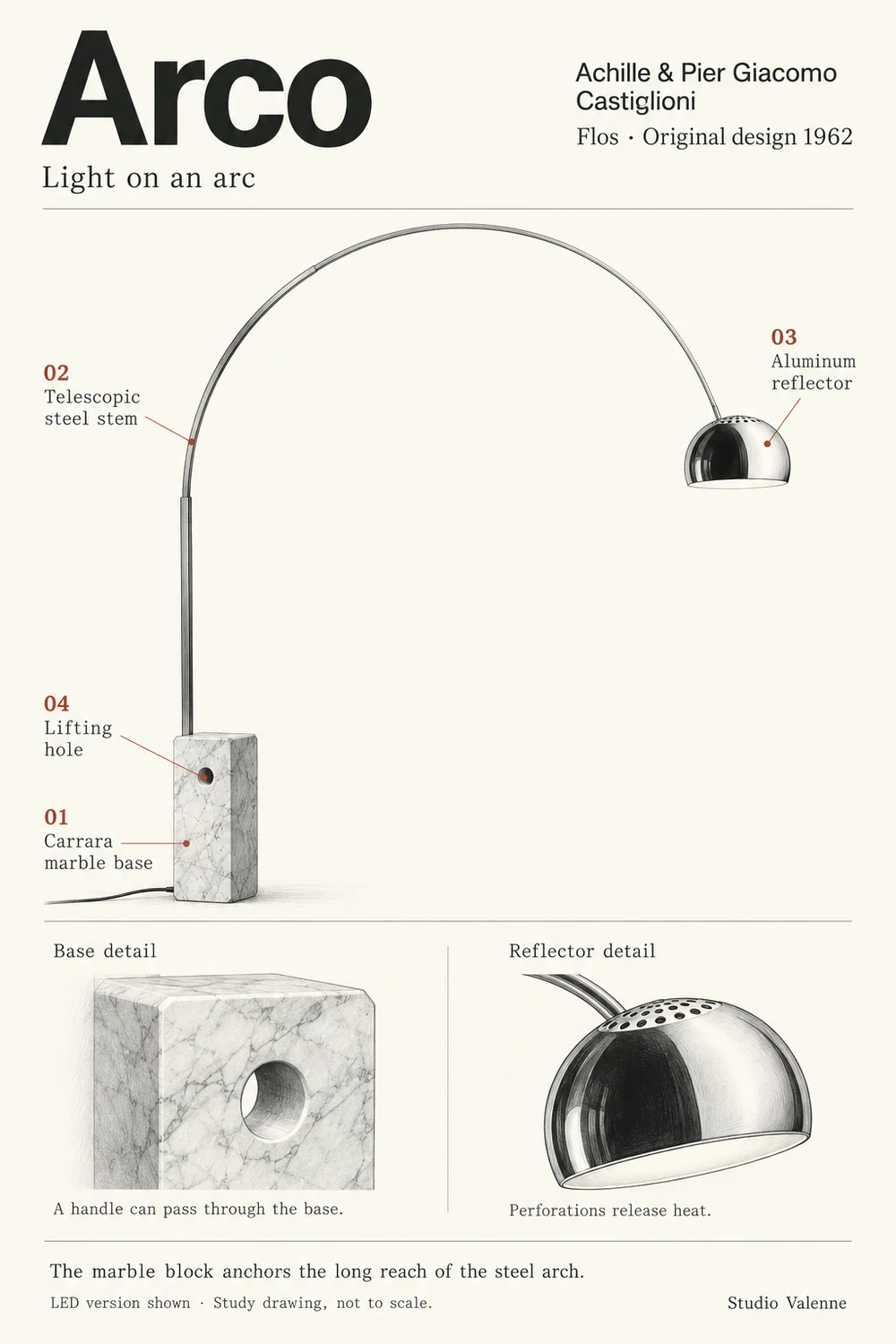
Achille and Pier Giacomo Castiglioni designed Arco for Flos in 1962. A heavy Carrara marble base anchors a telescopic stainless-steel stem, bringing the reflector away from the base and out over the space beside it.
Two small details are easy to overlook. The hole in the marble is functional: it provides a place for a lifting handle. Perforations in the reflector allow heat to escape. These are features to observe, not instructions for lifting or modifying the lamp.
The illustration shows the LED version, introduced in 2012. The original design date and the date of this later lighting version describe different things.
USM Haller — Fritz Haller and Paul Schärer
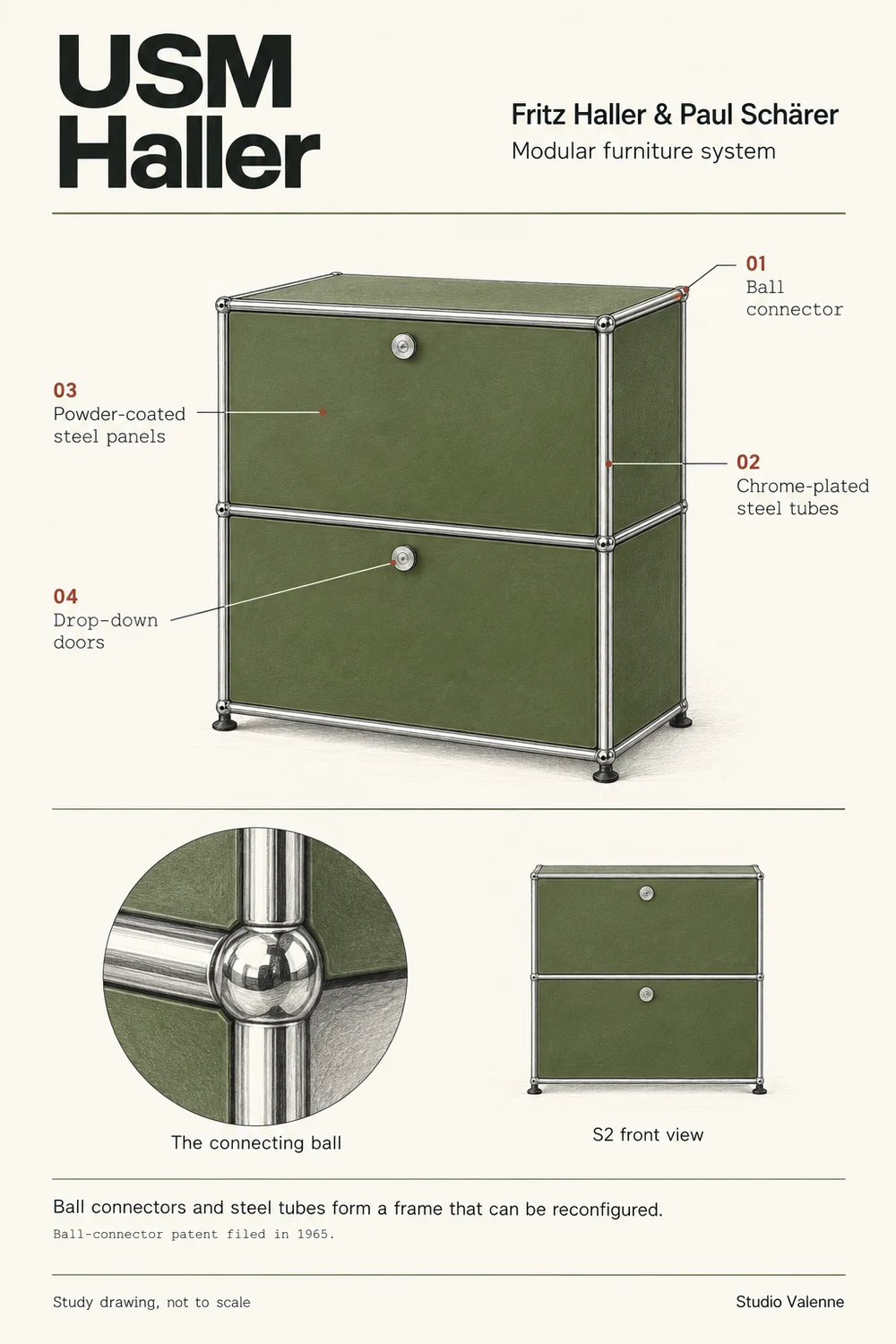
Fritz Haller and Paul Schärer began developing the system in 1962. The ball-connector patent was filed in 1965, and commercial series production began in 1969. Those dates belong to the system’s development, not to the current cabinet configuration shown here.
Chrome-plated brass connecting balls join chromed steel tubes. Powder-coated steel panels fill the frame. The olive-green S2 in the study is one bay wide with two stacked drop-down doors.
Start with the enlarged corner joint, then find the same connection on the cabinet. A small, repeated component makes the larger structure understandable.
How to read an object study
Choose one connection or material and follow it through the object. Does it support weight, shape a surface or join two parts? The answer is often more revealing than a long list of stylistic labels.
These posters are contemporary AI-generated editorial drawings, checked against maker references. They are not the designers’ original drawings, measured plans or assembly instructions. For dimensions, care and available variants, use the linked manufacturer information.
The reading shelf
Keep the material study going.
A lighting survey and a broader object reference offer useful comparisons across paper, wood, metal and glass.
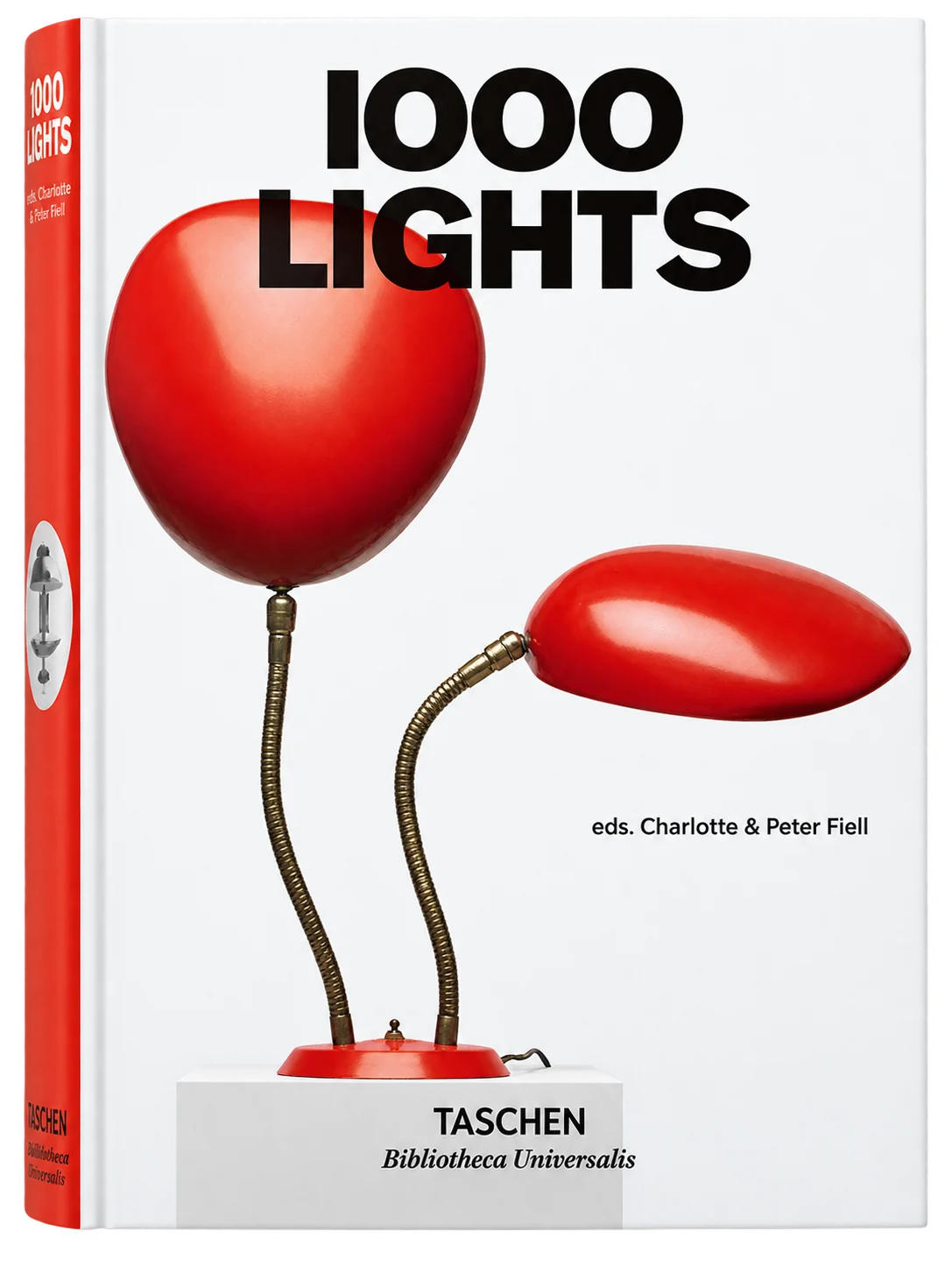
Charlotte & Peter Fiell · TASCHEN · hardcover
A chronological collection of lighting design, useful for comparing shades, bases and silhouettes.
Before you choose Choose the multilingual Bibliotheca Universalis edition; check the format and seller.
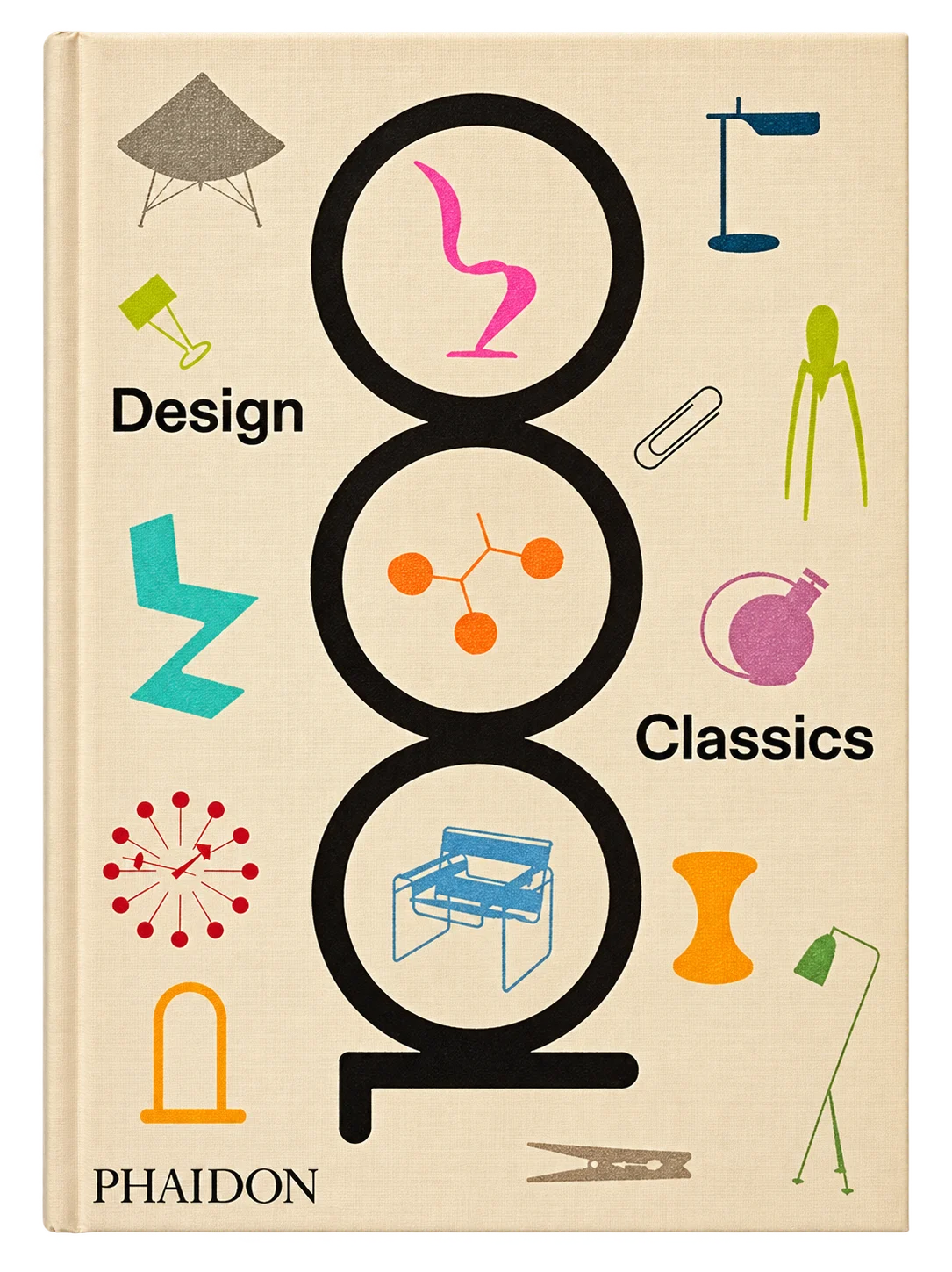
Phaidon Editors · Phaidon · hardcover
A broad visual reference that puts furniture, lighting and everyday objects in the same design history.
Before you choose A large-format reference book. Check the 2022 English-language edition and its dimensions.
Sources & editorial notes
The Noguchi Museum — Akari 1A · Checked 2026-09-28Carl Hansen & Søn — CH24 · Checked 2026-09-28Flos — The story of Arco · Checked 2026-09-28Flos — Arco and current variants · Checked 2026-09-28USM — Haller S2 sideboard · Checked 2026-09-28USM — Company history · Checked 2026-09-28USM — System materials · Checked 2026-09-28Practical suggestions are editorial judgments; adapt them to your needs. No personal product testing is claimed.